Friday, September 12, 2014

For cyclists like Benjie Kabakoff, bicycling is very much an integral part of their lives

For cyclists like Benjie Kabakoff, bicycling is very much an integral part of their lives
By:  Michael Lander

Benjie Kabakoff has been riding bikes for most of his life and
has ridden on a recreational and competitive level and now
regularly commutes in and around Memphis by bicycle.

For David "Benjie" Kabakoff, cycling is, and has almost always been, a very big part of his life. 

Kabakoff was born in
Whitehaven, (before it was incorporated into Memphis) in the mid-1950's.  His introduction to cycling began in what some might see as a rather inauspicious start.  His dad, who was a WWII veteran, decided that the best way to begin teaching him and his older sister how to ride a bike was by setting the two of them up on a small grassy hill, on a bike without training wheels, and giving them a good push to get them going. 

"I don't recall much about it other than we quickly learned to stay upright," Kabakoff said.

Years later, when he was of driving age, Kabakoff recalled that instead of wanting to drive a car, like most other kids his age, all that he really wanted was to get a
Schwinn Varsity Sport bicycle.  Even though he did learn to drive, Kabakoff said that he spent much of his time riding his bike all over Memphis from Whitehaven to East Memphis, to Boxtown (near Chucalissa), to downtown where his dad's store was, and even across the bridge to West Memphis, Ark.

As you might expect from someone who is really into cycling, in his senior year (in 1971) at Hillcrest High School, Kabakoff chose to write a research paper that only a true cyclist would find interesting - Derailleur Lightweights and Increasing Use of Bicycles in the United States.  He optically scanned his paper to editable text and it was published on the website of Memphis' only bicycle club - the Memphis Hightailers. 
 

(This is a link to what he wrote:  http://memphishightailers.clubexpress.com/docs.ashx?id=4292). 

Kabakoff attended
Tulane University in his freshman year and, even though he readily concedes that it was not exactly a bike-friendly time back then, he rode his bicycle all over New Orleans.

"I used to even race the trolleys on St. Charles Ave.," he said.

Kabakoff had even dreamed of riding his bicycles from New Orleans to Memphis, but it was a dream that he has yet to fulfill.

Like many other avid cyclists, Kabakoff rode his bike even when he probably should not have, including the time when he rode to a doctor's appointment in New Orleans.  The campus infirmary could not detect that he had mononucleosis, but the doctor determined that he indeed had it, which explained why he felt so tired all the time. 

In spite of this, he continued to ride anyway and maybe in some way it confirmed the old saying that, "what doesn't kill you, will only make you stronger."

Kabakoff finished his college education at
Rhodes, (which was Southwestern at Memphis at the time), and in his senior year there, he regularly rode his bicycle to school.  He continued to ride until he began his early career at Baptist Hospital.  After reporting a problem with a sprained knee, an orthopedic surgeon advised him to go easy on his knees and he decided not to ride his bike too much after that. 

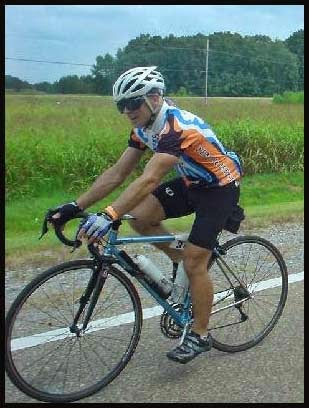
Benjie Kabakoff rides, on average, between 6,000 to 7,000 miles each
year.  This photo was taken of him after a rain fell during the 2010
FedEx Rock-n-Roll MS-150 bike ride, which is a charitable event
that benefits the National Multiple Sclerosis Society.

For years, Kabakoff stayed away from riding and picked up other activities like swimming, but it was on the advice of a friend and current swim coach at
Memphis Jewish Community Center (MJCC), Danny Fadgen, who said that bicycles had vastly improved since he last rode that prompted to to ride again.  He went out, and bought the lowest end Specialized Allez road bike that was available.

Even though he only planned to ride around the neighborhood, Kabakoff said that during his first year back to riding, (either late 2002 or 2003), he rode over 3,000 miles and he didn't even have an odometer for the first month or two.

Upon returning to cycling after a short hiatus, Kabakoff has remained dedicated to an activity that he truly came to love as a child.  He likes to joke that after years of unsuccessful therapy, that he is still addicted to it to this day.

In 2004, Kabakoff wanted to take his cycling to a more competitive level.  He felt like he was fast and he wanted to see just how well he could do against others, especially after he bought a fast bicycle.  That bicycle was a custom-made
Serotta with Campagnolo Record components. 

It was on that bike that he participated in a few Senior Games (Olympics) in which he did well at the local and state level.  He is modest about it and says that it was only because the most competitive cyclists did not show up at the events.

In 2007, Kabakoff was in the
National Senior Games and said that he went into it with the stated goal of not coming in last place or getting injured in the process.  He readily admits that he easily met his goals.

Since then, Kabakoff said that he is not at all interested in racing anymore.  He was mainly doing it, he said, to see how well he ranked against others.  These days, he believes that there is too much of an emphasis on competition in cycling.

"There is much more to be gained in riding slower, more safely, and enjoying the scenery," he said.

Along with cycling itself, Kabakoff also seems to enjoy doing bicycle maintenance and repair.  He
took a few maintenance classes at Revolutions Bicycle Co-Op just to see what I could learn and, in November 2010, he attended a series of classes at from Tony Griffin at Bikes Plus.

When it comes to doing maintenance and repairs, Kabakoff knew that he would never learn how to do it unless he went ahead and got the tools that he needed.  He considers the purchase of a few hundred dollars worth of tools a great investment as it allows him to make customized adjustments and one that satisfies his curiosity about the mechanical aspects of the bicycle. 

Even though monetary savings are possible, this is not the primary motivation for him.  Local bike shops remain an important part of the maintenance process for him in getting advice, parts, and alternative support for advanced and unusual type of repairs. 

After Hurricane Katrina in 2005, when President Bush encouraged Americans not to drive unless they had to, Kabakoff started commuting and has not stopped since then.  He rides throughout the entire year from the oppressive heat of summer to the bone-chilling cold of winter. 

Benjie Kabakoff, (kneeling in the center of this photo) is a member of Temple Israel team,
which is one of many teams that participate in the annual FedEx Rock-n-Roll MS-150 ride. 
Kabakoff has ridden in this and many other charitable bike rides over the years.  Also pictured,
(on the back row), is Karen Roth, Jeff Hirsh, Simone Loket, and Jed Weintraub.  Left of
Kabakoff, (in the front), is Sonny Solomon, and Vic Butcher is on the right.  Butcher is the team
captain and he has consistently been recognized as one of the top fundraisers for the FedEx 
MS-150 event in Memphis.

Until he decided to do this, he was mostly doing recreational cycling, but he found that he could combine this with an element of practicality by commuting as frequently as he possibly could.  He quickly discovered that he could ride short distances and go to the grocery store, shopping, and carry heavy loads with an inexpensive
NashbarCargo Trailer.

He learned many of the tricks of commuting on a bike from various articles in Bicycling Magazine and other periodicals.  One of these tricks that he picked up involved learning to adjust his travel routes according to anticipated traffic conditions.  

When he does drive to work, (which is at Baptist Hospital), he typically takes clothing (scrubs) to and from work.  He then carries only what is essential when he commutes via a bicycle; however, if necessary, he has also found that it is possible to load up everything that he needs in a back pack and carry that with him on his bike.

He routinely tries to arrive at work approximately 30 minutes early.  That additional time leaves him with plenty of time should he encounter any problems along the way, such as a flat tire, and, during warmer weather, it gives him sufficient time to cool off and to wipe away any sweat that he might have on him.

One of the most anxiety-producing events for Kabakoff is the possibility of getting a flat during winter months.  As anyone who is out in the cold long enough knows, the cold temperatures make trying to do things with your fingers a real challenge.  For that, he recommends
Bar Mitts, which he sees as the best passive device for keeping the hands warm.   For the most part, his commutes are rarely over an hour in the winter time, and his hands quickly recover with the use of the Bar Mitts.

For commuting, Kabakoff uses regular shoes with regular pedals and his commuting bike is the Specialized Allez road bike that he got over a decade ago.  The bike has had almost every part replaced on it, (some of which have been replaced several times), except for the handlebars and the frame. 

When he parks his bicycle at the grocery store, and elsewhere, he typically leans the cart and bicycle alongside the racks designed for people to leave the shopping baskets.  From there, he  locks the bicycle up with a cheap lock and a cable and bicycle alarms that he purchased in bulk from Amazon.com for about $4 each.


For the last two years, Kabakoff has split the mileage between his car and his bicycle at approximately 7,000 miles each. This year, he said, his mileage may be somewhere around 6,000 miles.

Kabakoff, like other avid cyclists in Memphis, is happy with some of the recent developments and changes in our river city and how much more cycling-friendly it has become.  He is particularly appreciative of Memphis Mayor
A.C. Wharton and his implementation of cycling facilities.

For cyclists like Kabakoff, it is a good time to be a cyclist in Memphis and the future looks bright for him and others who love to ride a bike in our city.

Wednesday, August 27, 2014

Here's Your Chance to Experience the 2014 Meritian Midnight Classic Bike Tour
By:  Michael Lander

Do you want to know what it's like to ride a bike in the middle of the night in Memphis?  If so, here's a video that will give you an idea of exactly what it's like:  https://www.youtube.com/watch?v=le4E-71bcpI&feature=youtu.be

Several current and former members of the Tennessee Air National Guard participated in this year's Meritan Midnight Classic Bike Tour on Saturday, August 23, 2014. Two of them, (Jon Tweel and Kevin Marconi), are featured in the video that was shot during this year's event.

The video was shot with a GoPro Hero 3+ and the music that accompanies this video is entitled "The Whip Theme," by Kevin MacLeod at incompetech.com.  For more information on cycling in Memphis, check out http://memphiscyclist.com/.

Wednesday, August 13, 2014

Meritan Midnight Classic Bike Tour offers the chance of fun for everyone

Meritan Midnight Classic Bike Tour offers the chance of fun for everyone
By:  Michael Lander

Memphis Mayor A.C. Wharton speaks to those gathered during the 2013
Lunar Festival as Meritan's President, Melanie Keller, looks on.  Keller
assumed the role of president after Deborah Cotney retired after 30 years
with Meritan in January 2013.

If you're looking for something that's fun, a little different, and involves riding a bike in the middle of the night, the Meritan Midnight Classic Bike Tour and Lunar Festival may just be the thing for you.

Meritan will be hosting its 15th annual Midnight Classic Bike Tour at midnight, Saturday, August 23, at Tiger Lane.  You might think that this would not necessarily be a big draw, but the event attracted more than 2,000 bicyclists last year and it is likely only to grow in the years ahead as more people in the Memphis area turn to cycling and they discover one of the best rides in town.

As it is, the bike tour is currently listed in Holly Whitfield's "I Love Memphis" blog as one of the 25 Things to Do in Memphis this summer and there are thousands of Memphians who would seem to agree with her.  Some might feel like it's a big party on bikes with many in and around Memphis out there.

The Meritan Midnight Classic Bike Tour is advertised as a leisurely, non-competitive bike ride that is open to all of those who love to ride, regardless of age or abilities.  Even though some might try to take it fast and see the ride as some sort of Tour de France, it is actually a much better experience when it is taken a little slower and seen as a late night/early morning Tour de Memphis with the emphasis on having fun with friends and family and seeing Memphis in a way that only comes once a year. 

One thing that many cyclists may find extremely appealing is the fact that, at least for a brief moment in time, you get the feeling that cyclists have taken over the city streets, that you own them, and that they belong almost exclusively to you and the thousands of other cyclists around you.  There are few opportunities when you ever get to enjoy that kind of feeling and to ride down streets in the heart of Memphis that you wouldn't otherwise be willing or able to ride on during the day.

One of the great things about this event is that it also brings people together as a community.  You will find both young and old and people of different shapes and sizes, cyclists of varying skills and abilities, and those who are from all walks of life and across the entire socio-economic spectrum.  The one thing that you will find is the common thread that ties all of them together is that they are there to ride, to have fun, and to do something that will benefit a good cause.

Participants in the Meritan Midnight Classic Bike Tour have a chance to
compete and win prizes for the best "bling" during the Lunar Festival
that takes place several hours before the bike tour at midnight.

The Midnight Classic Bike Tour event provides an evening of fun for those who participate and, from the proceeds of this,
Meritan is able to fund senior care, home healthcare, foster care, care for intellectually and developmentally disabled individuals and other vulnerable members within our community, along with skilled nursing care services.  Meritan is one of the city's largest non-profit health social service agencies in Memphis and was established in 1961.  It is a private, not-for-profit agency classified as a 501(c) (3) organization. 

In an interview on WMC-TV 5, with Kontji Anthony, on Saturday, August 16, 2014, Meritan President Melanie Keller said that the bike tour and lunar festival got started when the non-profit was looking for a signature event that would be a little different and that would emphasize Memphis and would bring the community together.


Prior to the start of the Midnight Classic Bike Tour, and beginning around 9:00 p.m., participants in the ride can partake in some pre-ride festivities, known as "the Lunar Festival"  where they can eat, tailgate, listen to music from
Gary Escoe's Atomic Dance Machine, and to compete and win some prizes for the best bling for themselves and for their bikes. 

The route is approximately 17 miles long, with
Memphis City Police Officers and volunteers stationed along the route for safety and to help guide you in the right direction.  It takes you through the Midtown, Cooper-Young, Central Gardens, Vollintine-Evergreen, and University District neighborhoods.  Click on the following link if you would like to view the tour route, courtesy of Donnie Webb (at http://www.mapmyride.com/routes/view/10039261).

Cyclists will have until 3:00 a.m. to finish the ride and they can be picked up if they are unable to complete it.  To help make everything go a little bit smoother, beginning this year, participants will start the ride in waves with the more experienced cyclists leaving out first.

Over the years, the start and finish of the bike tour was at various locations, with the first in Overton Square and then, up until 2012, it was at Poplar Plaza Shopping Center at the corner of Poplar and Highland.  In 2013, the location was changed to Tiger Lane (around the Fairgrounds Youth Athletic Fields) and it seems to be better suited to accommodate a large amount of people and vehicles with more space, parking, and adequate lighting.  It is also more scenic with the Liberty Bowl stadium lit up in blue with some green.

You begin the bike tour on Tiger Lane, (around the Fairgrounds Youth Athletic Fields), you travel north on Early Maxwell Blvd, west on Central Ave, north on S. Belvedere Blvd, east Peabody, north on Cooper St, west on Poplar, north on Stonewall St, east on North Parkway, south on East Parkway N., east on Union Ave, east on Walnut Grove Rd, south on S. Goodlett St, west on Central Ave, south on Zach Curlin St, west on Walker Ave, north on Patterson St, and west on Central Ave.


Prior to the Meritan Midnight Classic Bike Tour, participants are treated
to live music, like that of Gary Escoe's Atomic Dance Machine and to fun
events with the Liberty Bowl, lit up in blue and green, as a backdrop.

Organizers of the event seem to make every effort to make this a safe and enjoyable experience for those who participate and participants are strongly encouraged to wear a helmet.  Throughout the history of this event, there has only been one serious injury when a cyclist (Vincent Oglesby) was struck in a hit-and-run incident in August 2010. 

For the most part, the streets are adequately lit, but cyclists should have a headlamp so that they will be able to see the road in the one or two darker areas and so that they can be seen as well.  Having reflectors and a light on the back of a bike is also a good idea.

The biggest danger for participants comes from the sheer number of those who are riding, with a differential speed, (some going very slowly and some exceedingly fast).  There are also a good number who do the ride who do not give any verbal warnings when they are slowing down, about to stop, turn, pass, or if they see any road hazards.  With that being the case, cyclists need to be a little more alert and exercise a little more caution than normal when participating in this ride.

After finishing this bike tour, cyclists have the chance to meet with friends, family, and fellow cyclists while being treated to Central BBQ, Gibson's Donuts, and various beverages including Fat Tire Beer. 

Registration is $35 for adults and $20 for children, students, and military personnel with proper identification. To register, you can go to Meritan's website at Meritan.org.  For more information about this event, you can call (901) 766-0678 or you can visit their facebook page at https://www.facebook.com/MeritanMidnightClassic.

Tuesday, July 29, 2014

Cyclists can visit a place that they can call their island of dreams

Cyclists can visit a place that they can call their island of dreams
By:  Michael Lander
With its many stores, businesses, and restaurants, Main Street is often
one of the busiest and most congested areas on Mackinac Island.  During
the peak travel season of July and August, the sidewalks are usually full
of pedestrians and the street is often lined with bicycles and filled with
cyclists and horse-drawn carriages.


It might just be what almost every cyclist in the world ever dreams of..... A place that is filled with bicycles and where no cars are allowed on the roadways. 

For cyclists, a place like that might seem like the closest thing to nirvana or to heaven and for those who are willing and able to travel to northern Michigan, they will ultimately find what could very well be closest thing to paradise.   That little place of heaven-on-earth is called Mackinac Island.

Situated on Lake Huron, in between the upper and lower peninsulas of Michigan, Mackinac has no motorized vehicles, (except for a few used that are only used for emergencies).  Instead of cars, it has hundreds of horses, dozens of horse-drawn carriages, and more bicycles than you could possibly count. 

With all that, the island might not only feel like the promised land for cyclists, but from the moment that you first arrive, it might feel like you have literally stepped back in time.  

Cyclists can ride by some great scenery and many beautiful historic
homes, buildings, and places including a state park when they ride
on Hwy M-185 around the island.

After arriving on the island, with most coming by ferry, you are greeted by the sights and sounds that are reminiscent of a bygone era.  From homes, buildings and storefronts that mostly look like they were built in the 1800's, to the sounds of horses hooves as they clip-clop along the streets that are filled with cyclists and horses and carriages and streets lined with bicycles, and sidewalks filled with people, you can't help but feel that you have been transported to another time. 

With no cars, trucks, or motorcycles in sight, you can't help but think you have truly entered a land that time has forgotten.

While some might think that the idea of not having any cars on the road was done purely as a way to entice tourists, but the truth is that it was done because of them.  In order to preserve the more simple and quiet way-of-life for those who lived on the island around the turn of the 20th Century, the island banned motor vehicles in 1898 and made it a law in 1923.  In a way, this could be seen as a gift from those in the past to us to now enjoy today.
The 8+ mile ride around Mackinac Island offers some incredibly scenic
views for cyclists and others to see and it is just one of many roads
and trails for cyclists to ride and to explore the island.

The beautiful and picturesque island has about 70 miles of roads that includes some mountain bike trails and a 8.004 mile state highway (M-185) that encircles the outside perimeter of the island.  Highway M-185 is a narrow paved road that is the only state highway in the entire U.S. where motor vehicles are banned.  With no vehicles on the roadways, cyclists, runners, and walkers can really enjoy the beautiful and picturesque island without having to worry about the dangers or to contend with all the noise and exhaust fumes. 

The peak travel season for visiting Mackinac Island is in July and August with an estimated 15,000 tourists, but if you don't mind a little cooler temperatures, you can come earlier in the spring and into the fall.  There are plenty of bike rental places to get a bike and you can bring your own bike on the ferry, but you will be charged about $6.50 for each bicycle that you take over to the island.

While visitors have the option to walk, ride horses, or to take horse-drawn carriages, bicycles may the best and fastest mode of transportation around Mackinac Island.  The speed limit is 20 mph and violators can be charged with reckless driving for exceeding that speed, which isn't all that difficult to do on some of the roads with a precipitous incline.
Even though there are no cars on the roads on Mackinac Island,
cyclists do share the road with horses, horse-drawn carriages,
and hundreds of other cyclists.  The roads are far less congested
the further away that you get from the town.

With hundreds or thousands of bicycles on the road at any given time, the roads can be a little congested, especially on Main Street.  For the most part, the roads are relatively flat around the rim of the island, but there are several steep climbs for cyclists who decide to venture toward the center of it.  The most challenging of these include Grand (Cadotte) Avenue to Hoban Avenue that is northwest from Market Street, Spring (Turkey Hill) Street off of Fort Street and north to Huron Road, West Bluff Road heading southwest past the Grand Hotel, and Truscott to Huron Road going northwest.

The island is 3,776 square miles, altogether, and the highest elevation is 890 feet with the fortified earthen redoubt of Fort Holmes being the highest point.


Aside from trying to conquer some of the roads leading to the center of the island, there are many places worth seeing and spending a little time at.  This includes Fort Mackinac, the Grand Hotel, Arch Rock, Mackinac State Park, the Biddle House, the Wings of Mackinac Butterfly Conservatory, Skull Cave, Trinity Episcopal Church, the Stone Church, St. Ann's Catholic Church, and the military, Mackinac, and St. Ann Cemeteries.

For cyclists, Mackinac Island is truly a wonderland and a dream vacation spot unlike any other.  There are no other places in the world where a cyclist can ride without having to share the roads with cars, buses, trains and other modern modes of transportation. 

It is, in many ways, like a cycling utopia that may be an idea that some more progressive-minded cities and towns might be willing to consider someday, if even just for a small area set aside for people instead of vehicles.  It can be much like an oasis is for those in a desert.  It is, at the very least, something that we could all hope and wish for more of in the future.

To learn more about Mackinac Island, visit http://www.triplepundit.com/2013/10/mackinac-island-biketown-usa/

Tuesday, July 15, 2014

Tragic death of a cyclist, south of Memphis, should serve as a reminder of the constant need for caution and safety

Tragic death of a cyclist, south of Memphis, should serve as a reminder of the constant need for caution and safety
By:  Michael Lander

Canadian-born cyclist, Iain Gerrard, wanted to ride his bike from his home
in Toronto to New Orleans.  Unfortunately, he was struck and killed before
he reached his destination.

Iain Edward Gerrard was only 23-years-old when he died.  Gerrard was a cyclist from Toronto, Canada who was making a trip of a lifetime on his bicycle from his home in Toronto, to his ultimate destination of New Orleans, when he was hit and killed just south of Memphis.  The accident occurred on Monday afternoon, July 14, 2014, around 3 p.m. 

Gerrard was struck by an 18-wheeler just south of Memphis on U.S. Hwy 61 and Star Landing Rd in Desoto County in Mississippi.  DeSoto County Coroner, Jeff Pounders, is quoted as saying, in a DeSoto Time Tribune article, "Canadian cyclist struck by 18-wheeler," that Gerrard was traveling north in the southbound lane a half a mile south of Star Landing Road near Walls, Miss. when he appeared to have veered over in the lane of traffic and was hit.

The DeSoto County Sheriff's Office and the Mississippi Highway Patrol have not yet released any information or confirmed any details concerning this accident.

While there may be questions surrounding the circumstances of this terrible accident, for some, the thoughts are not so much on how it happened, but on who it happened to.  For friends, family, his parents, (William and Jean Gerrard), and for the cycling community as a whole, this is a sad time for them to grieve collectively over the tragic loss of a life that was taken too soon.  It is also a time when all of us are reminded of what could happen to any of us and what the loved ones of cyclists may fear and dread the most. 

As sad and as unfortunate as any loss of life like this is, it does help to bring to the forefront an issue that can never get enough attention and that is safety.  It can also serve as a warning, and as a cautionary tale, not only to cyclists, but to non-cyclists as well.

Since cyclists have a real vested interest in all this, they, more than anyone else, need to take the lead in making things safe for themselves while on the road.  This begins with not only knowing what to do and not do, but it includes following the rules of the road, and remaining as visible, vigilant, and as predictable as they can at all times.

Cyclists also need to take every opportunity that they can to remind everyone else that cyclists have every right, in the eyes of the law, to be on the roads.  Along with all that, cyclists should also establish goodwill with drivers and to try to be as a courteous and conscientious toward them, and to try to avoid doing those things that might unnecessarily annoy or aggravate them, like riding more than two abreast and not moving over to the right to let vehicles pass them. 

Drivers, for their part, should be as careful and cautious around cyclists with whom they share the road with and they should always try to have at least three feet of clearance between them and a cyclist.


It might take some time, but with a little effort on the part of cyclists, and as drivers become more accustomed to seeing more cyclists on the road, it should ultimately help to foster a culture of acceptance of cyclists in the community at large.

As terrible and tragic as it is for even one cyclist like Gerrard to die, when you consider the number of cyclists there are, and how many of them regularly ride their bikes, the number of accidents and fatalities in our area is lower than what some might expect.  We can only try to do our part to keep that number as close to zero as possible.

Statistically, the number of vehicles hitting cyclists and the number of fatalities associated with these accidents in the Memphis area seems to be relatively low.  Since 2010, there have only been three cyclists who have been killed, with the recent one in North Mississippi, one in Midtown Memphis on August 11, 2011, and another on the Hernando DeSoto Bridge on August 12, 2012.

Even though the greatest danger to cyclists on the road are collisions with vehicles, there are many other dangers that they might also face while riding.  Some of the potential hazards that cyclists might face include dogs, pedestrians or runners who might step out in front of you, other cyclists who might run into you, and even some unexpected problems, (gravel, potholes, etc), that you might suddenly encounter on the road itself.  With all of this, cyclists should always expect the unexpected and they should never get too complacent whenever they are riding their bikes. 

In spite of all this, this should not be enough to deter anyone from riding.  Life is full of risks.  The key for cyclists is to try to minimize any potential threats and risks that might come up on you, with little or no warning.  No one wants anyone to get hurt while cycling and none of us should expect anything less than as safe of an environment as possible for cyclists and anyone else on the road.

The world should never have to lose another young life like that of Iain Gerrard and we should all do what we can to make sure that it doesn't happen again.

To read more about bicycle safety and about Memphis area drivers and cyclists, click on the links to these stories: 
View of Memphis drivers may not be all bad from perspective of Memphis area cyclists and Questions and answers on bicycle safety.  For information on bike laws and driver's manuals in Tennessee, Arkansas, and Mississippi, visit the Memphis Cyclist website.

Saturday, July 12, 2014

Cycling's greatest event offers more than just entertainment

Cycling's greatest event offers more than just entertainment
By:  Michael Lander
Union Cycliste Internationale (UCI) sponsors worldwide cycling events for professional
cyclists including the Tour de France.  These events provide one of the most prominent
stages for cycling and it showcases one of the greatest challenges that exist in all of
sports.  This image was taken in July 2002 in Sankt Wendel in Germany. 
(Photo Credit:  Paul Wyatt)

For several weeks, every summer, the world gets an opportunity to witness some true athleticism and some incredible feats of human endurance and perseverance. 

While traveling along a route that spans approximately 2,200 miles, (3,664 kilometers), over mountains, through cities, towns and rural areas, some of the best in the world gather together to compete in a sport that is unlike anything else in the world.  It is the premier and renowned cycling event known as the Tour de France.

This year, the tour is hosting its 101st race, consisting of 21 stages with 22 teams, each one comprised of nine members, for a total of 219 cyclists who started on July 5, but which will have even fewer who will ultimately finish when the tour ends on July 27.

For those who love the sport, and are truly passionate about cycling, the tour is a must-see event that they look forward to each year.  Part of the obvious thrill for most is watching the strategy and jockeying for position, coupled with sprints to the finish line, but there is so much more that can easily draw someone in.  This is especially true for those who ride a bike themselves. 

More than anyone else, cyclists have a much greater understanding and a much deeper admiration and respect for those who participate in events like the Tour de France.  For some, the tour gives them a chance to live vicariously, and to imagine, if just for a moment, that they are actually one of the cyclists in one of the greatest of all races.

At another, more surreal level, this cycling event, and others like it, can also be seen and appreciated as if it were a form of art.  With a synchronicity of motion, the uniformity of movement with the cyclists leaning and turning as if there one, and with a gracefulness by which the bicycles seem to glide on the surface of the road, it can almost feel as if it is a moving canvas of color and motion laid out before us.

Even though very few people will ever earn the distinction of being able to get to the level at which they can participate in an event like the Tour de France, it does offer something for the rest of us none-the-less.  Not only can we be entertained by what we see, but it can serve as an inspiration and show us what any of us are capable of achieving through hard work, training, stamina, and a single-minded focus to succeed. 

When the race is done, and the yellow jersey is awarded to the winner, and other jerseys are given to other classification winners, we not only find who the best is in the world of cycling, but we have moment in time when we can admire those who can do the seemingly impossible. 

It is, however, not just a triumph for them, but for all of us since it demonstrates that, in spite of great adversity, we too may be able to overcome the overwhelming challenges that we face in our very own lives. With that, the tour also does more for cycling than just about anything else does by promoting it and giving it a stage that might otherwise go unnoticed by those who have yet to discover the greatness that it has yet to offer them.

To learn more about the Tour de France, watch CNN's Patrick Snell video on everything that you need to know to understand the tour and click on the following link for additional background information on it -  http://en.wikipedia.org/wiki/Tour_de_France.

Tuesday, July 8, 2014

Science and technology have forever changed cycling

Science and technology have forever changed cycling
By:  Michael Lander


Bicycles, as we know them, have been around for over two centuries.  Thanks to science
and technology, they have, over time, seen significant changes and improvements.  Those
who ride bicycles have benefited from this, and through other science disciplines, which
have helped to make cycling what it is today.  Even though the bicycle came centuries after
the great Renaissance thinker, inventor, and artist, Leonardo da Vinci, it is an invention
that he likely would have been intrigued and fascinated with.

Cycling, on its surface, might seem deceptively simple and easy.  It is, after-all, something that even a child can do.  At its most rudimentary and fundamental level, it only requires that a person keep their balance and that they keep peddling in order to stay upright and to propel oneself forward.

There is, of course, more to cycling than just that.  Behind the facade of what seems like the mere simplicity of cycling, there is a myriad of scientific disciplines that explain every facet of cycling and what we currently know can enhance the performance and overall experience for those who ride.

Ever since the initial concept of a bicycle was first created, (consisting of two wheels and requiring the rider to balance themselves in the early 19th Century), science and technology has played a key role in the evolution of cycling, (with many improvements and refinements), that have occurred over the subsequent decades.

Many bicycles that can be found today have extremely efficient gear mechanisms, and they are often composed of extremely durable and lightweight materials.  They are also capable of reaching speeds that generations of people, before now, could have only dreamed of.

Even with all of the improvements that have been made to bicycles, they still remain one of the few devices around that are powered exclusively by a person.  They are also one of the least expensive and one of the most environmentally-friendly means of transportation that can be found and there are few devices in places around the world that can serve both a practical purpose and can simultaneously yield remarkable health benefits.

Aside from the science involved with the composition and design of bicycles that exist today, there are other sciences that focus exclusively on aerodynamics, motion, body strength and conditioning, diet and nutrition, and just on the science of cycling itself. 

As much as science can explain and improve cycling, and help with improving the performance of cyclists, in the end, it cannot make you get out and get on your bike and ride.  You must have it within you to ride even when you don't want to, when it's hot, and when you're tired and sore.  The ability to do that has to come from within you. 

The actual experience of cycling, in some ways, almost seems to transcend science and mathematics itself.  Mathematicians calculate distances through equations, astronomers measure distance in light years, but cyclists actually live and feel distances with every breath and in many of the muscles in their bodies. 

With cycling, as with so many other aspects of our modern day lives, we seldom think about how much of an impact that science and technology has had on our every day existence.  We live in a world in which science and technology has forever changed and improved our lives and even cycling will never be the same because of it. 

The saying that "time stands still for no one," is true for all of us and we should all expect new and innovative changes to bicycles, and to cycling, in the future.  To read more about what we might see, visit  journal.ie and CNN Tech.  To learn why cycle cities are our future, check out an online article in arch daily.