Wednesday, April 6, 2016

Tunica hosts its Rivergate Festival from 14 - 16 April 2016 with its third annual bike ride on the 16th

Tunica hosts its Rivergate Festival from 14 - 16 April 2016 with its third annual bike ride on the 16th

Tunica is hosting its third annual Rivergate Festival Ride on
April 16, 2016.  The route this year will be similar to the
previous ones with the exception of a minor change to
the longer, 42-mile, Tour de Blues.

Within the Mississippi Delta, and set against an idyllic rural and agricultural setting, is the small town of
Tunica, Mississippi.

The town, like so many other Northern Mississippi towns, is an inviting and welcoming place filled with everything that makes small town living great.  That includes a southern charm and hospitality that makes you always want to come back for more.

Tunica, which is about 38 miles south of Memphis, is often only associated with its nearby
casinos, but for those who live there, or who have been there, all know that the town really has a lot more to offer its visitors, especially those who come to ride their bikes.

Once a year, cyclists have an opportunity to ride one of the area's bike trails when the town hosts its annual
Tunica Rivergate Festival.

This year’s festival will take place April 14 - 16, 2016.

“The Tunica Rivergate Festival is an annual event held in downtown Tunica each year since 1993,” the president and CEO of the
Tunica Convention & Visitors Bureau, Webster Franklin said.

The idea to include a 13 or a 42-mile bike ride as part of the festival is something that is relatively new and this year it will be on Saturday, April 16. 

“The inaugural Rivergate Ride originally took place in 2014…. and this will be the third year for it,” Franklin said.

The Tunica Bike Club, led by their president, Patrick Johnson, is responsible for this year’s Rivergate Ride and its route.

Click on this link for a brochure with a map of the bike trails for the
Rivergate Ride.

Of the two routes that cyclists can chose from, the shorter 13-mile “
Tour de  River” is ideal for all ages and skill levels.  This route loops around from the historic downtown area to a place known as Mhoon Landing on the Mississippi River and back. 

The longer, 42-mile “
Tour de Blues” route is a little more challenging ride that travels along Mississippi Delta roads and part of what is known as the Great River Road Scenic Byway.  Throughout the ride cyclists will ride past some of the area’s cultural landmarks that gave this trail its nickname of Blues Alley.

Tunica is a place where cycling is becoming even more
popular.  With events like the Rivergate Festival bike
ride and the creation of a local bike club in town,
the popularity of cycling is expected to grow in
the years ahead.
 
“All riders this year will start together at the Town Hall in downtown Tunica at 8:00 a.m. and they will ride the entire Tour de River route that features the Mississippi River at Mhoon Landing Park,” Franklin said.

“The riders will have the option of crossing the Mississippi River Levee, and getting a scenic view of the Mississippi River, or turning just before the levee crossing and continuing along the route,” he said.

“The Tour de River route will conclude in downtown Tunica with the Tour de Blues continuing south around Beaver Dam Lake.  There will be a SAG stop in downtown where those riding the Tour de River will complete their ride and those continuing on the Tour de Blues route can stop before resuming the rest of their ride.  An additional SAG stop will be offered at the 25-mile marker,” he added.

Other than the minor route change to the 42-mile route, cyclists who have done the ride before can expect the same type of ride and festival atmosphere that they experienced during last year’s event.

Registration for this year’s ride begins at 7:00 a.m. at the Town Hall at 909 River Road and the ride begins at 8:00 a.m. 

Online registration can be found at
https://www.racesonline.com/events/tunica-tour-de-blues and the cost is $25 until April 15.  On the day of the ride it will increase to $30.

Every cyclist will receive a welcome bag upon check-in, which will include the official Tour de Blues t-shirt and various other items.  The t-shirt is a part of the registration fee.

Law enforcement will be stationed at all of the major intersections along the way.

After the ride, cyclists will have the chance to enjoy some food, fun, and beverages
at the Rivergate Festival in Downtown Tunica.  For Franklin, one of the best parts of the ride is that it is a part of a bigger Rivergate Festival experience.

The festival offers the chance to take in some live entertainment all day, with family and children’s activities, and all the beer and crawfish you could possibly want.

Last year’s ride had a total of 85 cyclists, with 30 who did the 13-mile ride and 55 who opted for the longer, 42-mile, ride.

The Tour de River and the Tour de Blues bike rides drew
85 cyclists during last year's Rivergate Festival and
participants are encouraged to bring their families
with them for the entertainment, food, and
family activities throughout the day on Saturday,
April 16th.  (Photo:  Courtesy of Tunica Convention
& Visitors Bureau)

“We hope to expose the ride to more people and to increase participation to over 100 riders this year,” Franklin said. 

Franklin credits Lynn Ryals, who is the former Executive Director of Tunica Main Street, for initially organizing the ride. 

“Under her leadership, Tunica Main Street developed the
Tunica County Bike trail that links DeSoto County to Tunica County.  The trail is marked with road signs and a brochure has been developed by Main Street in an effort to promote the trail,” Franklin said. 

The official opening of the bike trail took place in March 2013. This was a 13 mile ride from downtown Tunica to the Mississippi River at Mhoon Landing and back.

“Cycling in Tunica is still relatively new, but we have grown from just a few true road cyclists to over a dozen and the formation of our very own Tunica Bike Club,” Franklin said.

“Tunica’s Bike Club was established in 2014 and its headquarters is located just south of the Tunica Town Hall on Edwards Ave.  The club has assumed responsibility of organizing the ride and its members and their spouses look forward to welcoming all cycling enthusiasts to Tunica for a great ride.  They invite all riders to stop by and they will be more than happy to answer any questions about the ride or the activities taking place over the weekend,” he said.

The Tour de River and the Tour de Blues are part of the larger Tunica Rivergate Festival activities, according to Franklin. 

“This year marks the 20th anniversary of one of the festivals main attractions –
Crawfish Alley.  The Rivergate Festival, itself, actually begins on Thursday, April 14 and continues through Saturday afternoon, April 16, with entertainment, food, and family activities.  We invite all participants in the ride to bring their family for a full day of fun in downtown Tunica,” Franklin said.

Cyclists, who have not already experienced it before, can learn firsthand of the Tunica small town charm and hospitality during the ride and at the Rivergate festivities afterwards. 

Those looking to learn even more about the town and the local area can visit one of the three museums in Tunica County – the Tunica Museum, the Tunica River Park, and the Gateway to the Blues Visitor Center and Museum.  Information on all of these attractions can be found at: 
www.tunicatravel.com.

Thursday, March 10, 2016

It's time that we embrace the idea that the streets belong to all people

It’s time that we embrace the idea that the streets belong to all people
By:  Michael Lander

This is another take on the word - Coexist -
that was created to promote the continuing
efforts to include cyclists and pedestrians
on our streets.

“The streets belong to the people.”

In the
representative democracy that we live in, there seems to be something that is quite appealing about the idea that all people have an equal right to certain things, like our streets, which have been constructed for the good of us all and, in many ways, belong to us all.

This statement that “the streets belong to the people,” though, actually began as a
rallying cry in 1912 when suffragettes were wanting to march on New York City streets in their fight for a woman’s right to vote.

In the ensuing decades that followed, and long after women finally secured the
right to vote in 1920, this rallying cry could have easily taken on a new meaning as a growing number of community activists, and bicycling advocates, sought to make the streets much more accessible for all people, and not just those who were in motor vehicles.

Throughout most of the Twentieth Century, cars and trucks, in the U.S., for the most part, ruled the roads, and a lot less consideration, or accommodations, were rarely ever made with cyclists and pedestrians in mind.

By the late Twentieth Century, however, this began to slowly change in dozens of cities across the U.S. and, today, most now see the value of having streets that are safe and much more accessible to all people.

Click here to read the
history of bikes and American society by the League of American Bicyclists and see the role that cycling advocates played in making U.S. city streets better for everyone.

Even though much progress has been made in making the roads much more accessible, and more bike and pedestrian-friendly, not all motorists have gotten on board with the idea.

This is a promotional banner to remind motor vehicle
operators to share the road because they belong to
everybody.

Attitudes can sometimes be the last thing to change and the attitudes of some motorists haven’t necessarily changed with the times.

As roads have become a lot more congested with vehicles, and as more and more cyclists have also begin to hit the roads, too, there can be an intensifying competition for a limited amount of road space, and any inconveniences, momentary delays, or any real or perceived failures of cyclists to observe the rules of the road, etc., have occasionally led to greater problems, dangers, and even road rage against cyclists.

It might seem difficult to know how to mitigate any of the us-(cyclists)-verses-them-(motorists)-mentality, but the best place to start might begin with education. 
 
In spite of all of the efforts that have been made, to this point in time, there are still some out there who are blissfully unaware of the fact that
cyclists have every right to be on the road and simply telling these folks that the streets belong to people and not cars would likely do very little to sell them on the idea or to get them to change their minds one iota.

The only hope for cyclists is that people will become better educated prior to being issued a driver’s license and that they will be periodically reminded, (be it public service announcements, etc.), that cyclists do have every legal right to be on the roadway, too.

In addition to that, motorists should also know that, by Tennessee State law,
vehicle operators should have three feet of separation between their car and the cyclist and that they should view a cyclist no different than any other vehicle operator on the road.

Cyclists, for their part, must be willing to do what they can to help minimize some of the problems and they can do this by observing the rules of the road, being considerate and conscientious, and by becoming public advocates who are willing to regularly get their message out to the public.

This image is a reminder that our streets belong
to everybody and not just for motorists.

Cyclists should also be politically active and to support those who support them.  Vote for those who are willing and able to promote a bicycle-friendly environment with an infrastructure that benefits all people that includes both cyclists and pedestrians.

Sometimes, it would seem that our local, state, and federal legislatures will take steps backwards on issues that might negatively impact cyclists and pedestrians so it is always important for cyclists to remain vigilant, to voice their objection, and to take action whenever this occurs.

Recently, a Tennessee State bill has been proposed that would restrict the use of funding (from a possible future gas tax) on any bicycle and pedestrian projects throughout the state. 

Click on this link to let your voice be heard on this issue: 
http://www.peopleforbikes.org/page/speakout/save-bike-funding-in-tennessee

Cyclists and pedestrians should attempt to stop any legislation that might minimize or thwart any spending on future cycling and pedestrian projects. 

Since most cyclists and pedestrians have cars, and they pay the very same sales and property taxes as motorists do, which are used to help build and repair the very same roads that we all walk or ride on, they should not be excluded in how those tax dollars are then spent.

One possible solution, that would come at a cost, but would be a potentially safer alternative for cyclists, is one that would get the cyclists off of the road and would eliminate the need for them to share the same lanes with cars.

This alternative could come with
protected bike lanes that would physically separate cars from cyclists and would give the cyclists their own lanes, instead.

As good as this idea might seem, however, there are some who have serious reservations about pursuing this.

John Forester, who is a bicycling engineer from Lemon Grove in San Diego County, is one of them.

This image is a way to promote the
benefits of cycling.  As more people
begin to see the value of cycling, and
more people begin riding, more will
be done to better accommodate them.

Christine Aschwanden in her article,
“Bikes and Cars:  Can we share the Road?,” describes Forester as being the father of the “vehicular cycling movement,” which she says “is a philosophy that views the bicycle as a form of transportation on the streets alongside cars.”

Forester, and others like him, she says, believe that efforts to push bikes into separate lanes or bike paths only help to reinforce the notion that bicycles don’t belong on the street in the first place and that it relegates them into a separate and not-quite-as-equal status.

If the protected bike lanes are not the panacea that they would seem to be, they could at least be an option in certain circumstances, especially on highly trafficked roadways or where it might enhance the flow of traffic and safety for vehicles, pedestrians, and cyclists.

Ultimately, most cities will eventually have to grapple with these issues, if they haven’t already.  Times are changing and they need to.  It has already taken too long to get where we are and we can’t afford to go backwards now.

We must all learn that we can and must coexist and be willing to share the road and every person, city, and the entire nation needs to become more bicycle and pedestrian-friendly.

The roads were not just built for cars and people don’t get the sense of community until they get out of their cars, and begin to walk or ride their bikes around in and around their neighborhoods. 

As soon as we all realize this, and embrace that, we will finally get where we need to be in this country.

The streets truly belong to the people and all people have the right to be on the streets.

Sunday, March 6, 2016

New park in West Memphis, Ark. will be a 'must see' destination for cyclists from Memphis and beyond

New park in West Memphis, Ark. will be a ‘must-see’ destination for cyclists from Memphis and beyond
By:  Michael Lander

The welcome to Arkansas sign on the Hernando DeSoto Bridge
is what vehicle operators see as they leave Memphis headed
toward West Memphis, Ark.  Within the next year, a new
park will be in place in West Memphis that will be located
along the shoreline of the Mississippi River.

When it comes to great parks in
West Memphis, Ark., there is one that does not yet exist, except on paper, but within a year, however, this park is expected to emerge from the shoreline of the Mississippi River to become one of the most popular and frequently visited parks just outside of Memphis.

This new park will be known as “
Eco-Park” and it will be located along the banks of the Mississippi River and perfectly situated directly across from the City of Memphis.

It will be a distinctively unique place, and unlike any other Memphis area park, in that it will be directly connected to a multi-state trail system and it will be the only place with a scenic view of a the Mississippi River juxtaposed against the magnificent Memphis city skyline. 

The park will also be completely encapsulated within a natural and rural setting that visitors from all walks of life, and from all over the world, will be able to appreciate.

The creation of this new park will be the fulfillment of a quest that began in the mid-1980’s.

The Hernando DeSoto Bridge spans the length of the
Mississippi River and connects Memphis to West Memphis,
Ark.  Thousands of vehicles drive over the bridge each day
and just below them, on the Arkansas side, will be West
Memphis' Eco-Park.

“West Memphis has been interested in developing a park along the river for about 30 years,”
Paul Luker said.

Luker is the Director of Planning and Development for the City of West Memphis, Ark.

“The
Main-to-Main Project (or Big River Crossing) reinvigorated our efforts and we started planning the Eco-Park four years ago,” Luker said.

“In the beginning, we worked with the National Park Service River and Trails Division to develop the concept.  We then partnered with the
University of Memphis and the Regional Planning Department to develop a master plan with funding from a Mid-South Regional Greenprint grant,” he said. 

“Last fall, we teamed up with the
Big River Strategic Initiative to secure $1.5 million in funding to start construction on the first trails that will eventually connect directly to the park.  We hope to begin construction in late spring or early summer,” he added.

This is a view of the Memphis skyline that visitors to Eco-
Park will see in West Memphis, Ark. within the next year.

Luker describes Eco-Park as being a flood-way version of
Shelby Farms Park and said that it will have a geographic location that will be at the crossroads of the main-to-main street trail and the Big River Parkway, which will be one of our regional trail systems.

The park will ultimately be connected to a trail system, which should be extremely popular with cyclists, from
St. Louis to New Orleans and it will be a destination spot for those coming over “The Big River Crossing” (the Harahan Bridge) from Memphis.

Luker believes that the park will have one distinctive feature that no other park in the area can offer.

“Being able to get an up-close view of the Mississippi River and to see the Downtown Memphis skyline in the background, while being in a completely peaceful and rural setting, should provide an incredible, one-of-a-kind experience to visitors,” Luker said.

“This entire project (with the trails and park) will also be a very unique opportunity for the area to expand the green infrastructure throughout the greater Memphis metropolitan area,”
Terry Eastin said.

This is a view of the Memphis skyline from where the
future Eco-Park will be located in West Memphis.

Eastin is the Executive Director of the Big River Strategic Initiative who also serves as the chief fundraiser and coordinator for the
National Geographic Geotourism Initiative along the Mississippi River.

“Our hope is that the new park and trails will offer a myriad of choices for recreational use to include bicycling, walking, bird watching, natural environment studies, or a host of other recreation-conservation opportunities,” Eastin said.

The new park, and the trails leading to it, will become a game-changer for West Memphis.

“The new park and trails will be a big tourist attraction and it will be a quality of life improvement for us that should also bring significant economic development to our city,” Luker said.

“In addition to the positive economic development, the expansion of the trail system and the park will also provide opportunities for improving health and wellness in an area with a high incidence of an under-served population.  Ultimately, the system in the park area will connect directly to the levee trail offering a multitude of opportunities for recreational enthusiasts and hardcore trail users,” Eastin said.

This is a close-up view of the Memphis skyline from across
the Mississippi River in what will be Eco-Park in West
Memphis, Ark.

“A connected pathway system from Memphis to West Memphis to New Orleans will be completed in the first three phases with additional linkages north to St. Louis in phases four through six,” she added.

For now, Eastin is not able to provide a specific time frame for a completion date for the entire trail system.

“The first 73 mile of levee top trail from the border of
Marion to Marianna, Ark., though, is expected to open in October 2016 and it is being funded, in part, through an Arkansas economic development grant.  Associated costs are determined when new projects that impact the overall system are developed,” Eastin said. 

“Hopefully, within five years, large sections of the Arkansas corridor will be open,” she added.

Even though the park will be located on a flood-way, and will be flooded about one month out of the year, Luker and his staff are taking this into consideration in their design and planning.

Eastin doesn't anticipate any similar issues with the trails leading to the park since they will be elevated, along the levees, and this will provide a better vantage point for seeing the surrounding terrain.

This is a view from atop the river bluff in Memphis with
Tom Lee Park in the forefront and the Mississippi
River and West Memphis, Ark. beyond that.  Eco-Park
will be located along the shoreline in West Memphis.

“The
Mississippi River levee system is the largest man-made system in the world.  A predominant problem with river tourism in the Delta is the fact that the levees currently block views of natural areas and the river itself.  Having the trails on the levees, themselves, will eliminate this problem,” Eastin said.

Besides West Memphis, Eastin also envisions other cities benefiting from a levee trail system along the Mississippi River.

“The system will bring new economic lifeblood to the small communities along the river.  As more people access the system, new business ventures will arise to meet tourism demands,” Eastin said.

Along with the cities that will benefit from all this, cyclists also stand to benefit from all this since bikes will be the best and fastest way to travel on the levee trails and
Arkansas, according to Eastin, is focusing much of their attention on those who ride.

“Arkansas is working on a tourism program aimed solely at attracting cyclists and trail users, globally.  Draft plans include developing and hosting ‘trail community tourism’ programs across the state,” Eastin said.

This is a diagram of the first of the proposed phases of levee
trails in Arkansas.  This one depicts the Delta Regional
River Park Trails, which will be located along the
perimeter of Eco-Park with one leading it up to
it from the Big River Crossing.

“Many global visitors will be fascinated with seeing large expanses of agricultural production in Arkansas, including the size and scale of equipment used in the process, and other things like the largest remaining hardwood forests in the nation,” she added.

Through her work with the Mississippi River National Geographic Geotourism program, Eastin hopes to see more economic opportunities to local businesses that will give tourists a chance to see, taste, and experience life in the areas that they visit.

“The Mississippi River National Geographic Geotourism program is a joint project of a major Mississippi River collaborative between the Big River Strategic Initiative, the
National Park Service, the U.S. Fish and Wildlife Service, Delta Regional Authority, the U.S. Army Corps of Engineers, and Mississippi River Parkway Commission,” Eastin said.

“This was created to support recreational and educational tourism, and awareness, along the entire Mississippi River corridor,” she added.

This is a photo of the Hernando DeSoto Bridge in the foreground
and the Harahan Bridge in the background.  The Hernando
DeSoto is almost exclusively used for motor vehicles, but
the Harahan will have a pathway that will enable cyclists
and pedestrians to cross over by the end of 2016.

The program, according to Eastin, is designed to capture the essence of a region and to provide a marketing and tourism platform for business owners and recreational interests.  There have been meetings in hundreds of communities to introduce the program and to share ways for businesses and private individuals to participate.

“Typically, local venues cannot compete with global chains, but with this program, tourists have the chance to experience the ‘realness’ of a locale and stay, eat, sleep, and recreate in places that have been vetted by National Geographic’s staff and local residents,” Eastin said.

“Best of all, there is zero cost for participation in this program, thanks to the generous grants and donations provided by Delta Regional Authority and others,” she added.

With the park and the levee trails, Eastin sees a bright future for Memphis and West Memphis. 

This is a close-up of the Hernando DeSoto Bridge in the
foreground with the Harahan (with the Big River Crossing)
for cyclists and pedestrians in the background.

“These new amenities are offering more people a way to expand their lifestyle and to enjoy the natural environment in ways many have never experienced previously.  They are the foundation of a better economic and social health,” Eastin said.

“Like
Little Rock in the early 2000’s, the Memphis area has turned the corner toward an era of healthier living, more green infrastructure, and better alternative transportation systems, and it now is positioning itself to be one of the South’s finest examples of quality living,” she added.

With the Eco-Park, and the levee trails, the Memphis area will make its mark and will soon become a destination stop for cyclists from around the world who will want to come, spend a little time, and to experience what we all know and love about the place that many of us proudly call home.

Saturday, March 5, 2016

Tulsa's after-school bicycle program is a big hit and a perfect model for other cities to emulate

Tulsa's after-school bicycle program is a big hit and a perfect model for other cities to emulate
By:  Michael Lander

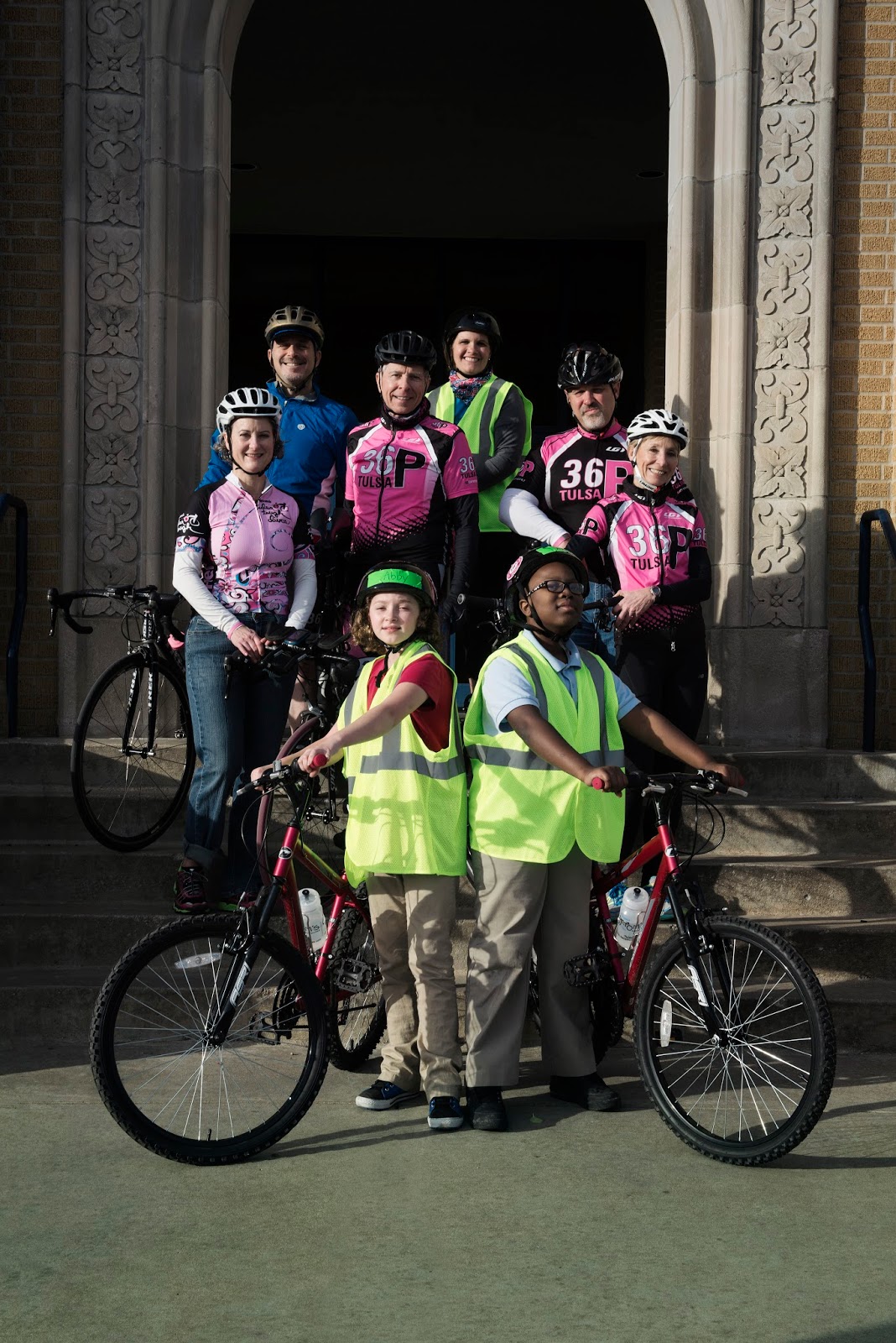
Tulsa's after-school bicycle program, known as -
Bike Club, is wildly popular with students,
parents, and others.  This is a photo of two
Robertson Elementary Bike Club members and
a half-dozen volunteers who have helped to
make the program as successful as it is. 
(Photo:  Courtesy of Melissa Lukenbaugh)

The Tulsa Public School system in Oklahoma, along with the help of dozens of volunteers from some bike teams and bike clubs, and a handful of local area businesses, is blazing a trail with an after-school bicycle program that has been viewed, by many, as being incredibly successful in so many different and wonderful ways.

This after-school bicycle program is called “Bike Club” and it is making a positive difference in the lives of children and it is wildly popular with parents, teachers, school administrators, and students alike.

The club is in its second year, having begun in 2014 to 2015, and it teaches important lessons about bicycling to students in grades four through six in half a dozen elementary schools in Tulsa.

Bike Club not only teaches these students about important lessons that are required for riding a bike, but it also provides them with other valuable life lessons that they might not necessarily get in a classroom setting.

Most importantly, the after-school bicycle program does all this without leaving out one of the best things of all to these young men and women – it doesn't leave out the element of fun and adventure that comes along with riding a bicycle.

“Bike Club helps students to learn about bicycles, bicycle safety, simple bicycle maintenance and bicycling riding,”
Gary Percefull said.

Percefull represents District 1 on the Tulsa School Board of Education.

“The first semester is mostly spent on or near each campus and students become proficient on the bikes and learn street safety.  In the second semester, they are taken off-campus and they go on field trips,” Percefull said.
 
“We have also been able to provide a USA BMX Stem Kit to each Bike Club school so on indoor weather days the students can work on drills, exercises, and on building bikes,” he said.

Bike Club has made a big difference in the
lives of its students while teaching them
about bicycling and a lot more.  This is
one of the Bike Club students at
Robertson Elementary.  (Photo:
Courtesy of Melissa Lukenbaugh)

For Percefull, what the students learn off of their bikes, however, may be just as important as what they learn on them.

“There is a lot of mentoring and role-modeling going on.  Bike Club works on teaching the students life skills like teamwork, respect, and cooperation, too,” he said.

“The bicycles that the students in Bike Club ride throughout the school year are provided by
Humble Sons Bicycle Company through generous charitable donations from individuals and businesses in our community,” Jason Whorton said.

Whorton is the co-founder of Humble Sons Bike Co.

“The bikes stay at school during the school year and are given to the students at the end of the year,” Percefull said.

“The Bike Club is 100 percent volunteer-based and several bike teams like Team Crude, Team Tom’s Bicycles, Team Air Assurance, Team 36P, Team Soundpony, the Tulsa Bicycle Club, and bike shops in Tulsa have provided volunteers, equipment, and support for it,” he said. 

“Humble Sons Bike Company provides bikes, helmets, and other associated equipment and supplies through its funding.  No direct funding has come from the school district, but several individuals and philanthropic organizations have made some very generous contributions to support Bike Club,” Percefull added.

“Humble Sons became involved when the Tulsa Bicycle and Pedestrian Advisory Committee (BPAC) member, Mike Wozniak, approached me and he and I have been working together developing Bike Club ever since," Whorton said.


"My bicycle non-profit was especially interested in the Bike Club initiative because it leveraged our donation of a bike and helmet, but it also provided safety training and encouraged successful navigation (and emphasis) on the ‘ABC’s’ – Attendance, Behavior, and Coursework,” he said.

All of this is in line with Humble Sons’ mission to “provide children access to bicycles and promote safe riding practices to encourage active lifestyles,” he added.

According to Percefull, there were 25 students enrolled in the after-school bicycle program last year and this jumped up to 150 students in the second year (2015 to 2016). 

Volunteers for students in Bike Club not
only teach the student how to ride a
bike, but they can also be role
models for them and help
guide and influence them to
achieve success in life. 
(Photo:  Courtesy of
Melissa Lukenbaugh)

“This year, six elementary schools have a bike club.  We are looking at a possible expansion of nine to 12 schools next year.  Future growth will depend heavily on the ability to recruit adequate volunteers who can participate in the program, beginning around 2:30 to 4:30 p.m.,” Percefull said.

For Percefull, the Bike Club, thus far, has greatly exceeded all expectations.

“The overall response to this program from the teachers, parents, and the community as a whole has been fantastic.  There is such great interest and offers to help.  Everyone seems to love Bike Club and wants to be involved or supportive of it,” Percefull said.

“The principal from Emerson Elementary School, Tammy States, told me that Bike Club students have taken more of a leadership role, not only in the Bike Club, but also in their classrooms.  They feel good about themselves because they are part of something that is unique,” he said.

“The principals, counselors, and faculty sponsors report that Bike Club has been huge in supporting and encouraging good behavior, attendance, and coursework,” he added.

Like Percefull, Whorton, too, has heard some very positive things about the after-school program and has even gotten some feedback from parents, himself.

“This past week, I got a note from a parent, which said ‘Thank you guys for allowing my son into Bike Club.  I have noticed he has opened up with people and it has helped his confidence,’” Whorton said.

The most rewarding part for Whorton, himself, is seeing what Bike Club has accomplished and what he gets from the children, themselves.

“Watching this idea go from one bicycle club to a community engagement program that has impacted hundreds of lives in two years has been great and you got to love seeing those smiles each time the kids ride,” Whorton said.

Bike Club teaches students, like this one
from Remington Elementary, about
bicycling and it can benefit the
students with improvements
in behavior and in academics.
(Photo:  Courtesy of Melissa
Lukenbaugh)

Percefull has been especially impressed with how the Bike Club has evolved into something bigger than what he first envisioned.

“This has really turned into a community engagement program that is bringing Tulsans together around bikes.  The Bike Club’s mission statement pretty much sums it up - ‘Building confident cyclists and great Tulsans through community engagement,” Percefull said.

For Whorton, the key to continued success comes through expanding the pool of dedicated and passionate volunteers.

“We are committed to developing systems that give our volunteers easy access to registration, training, and other tools needed to be successful,” Whorton said.

Whorton has several suggestions for other cities that may be looking to establish and maintain a similar after-school program, themselves.

“You should consider putting together an advisory team - It’s hard to connect all of the dots by yourself.  Also, be sure to take care of your volunteers.  Volunteers are everything,” Whorton said.

“We have progressed by developing relationships with people who share similar interests and goals.  Don’t be afraid to ask for help or to be told ‘no thank you.’  Just ask enough like-minded people and someone will say ‘yes, I want to support this',” he said.

“Every school, community, and city is different and what works in one place, might not work in another.  Just be creative with how you leverage your community partners and resources around each school,” he added.

With a committed group of individuals, philanthropic organizations, businesses, and dedicated volunteers, other cities like Memphis may be able to have the same level of success that Tulsa has had with their increasingly popular and expanding after-school bicycle program.

For the sake of the children in other school systems around the country, after-school programs like the one in Tulsa, is certainly worth the time and investment in those who are our future.

Tuesday, March 1, 2016

OAM Network in Memphis launches a podcast program for cyclists

OAM Network in Memphis launches a podcast program for cyclists
By:  Michael Lander

Sara Studdard, of Explore Bike Share, and Kyle Wagenschutz, who
is the Memphis Bicycle/Pedestrian Program Manager, are hosts
of - The Bike Nerds podcast, which will provide Memphis area
cyclists, and other listeners, with in-depth and informative
discussions on cycling and livability topics.  (Photo:  Courtesy
of - The Bike Nerds)

If you love cycling, and you’re really interested in hearing more about it from those who are involved in creating a bike-friendly environment in the
Memphis metropolitan area, then “The Bike Nerds” program is for you.

“The Bike Nerds” is a podcast, by the
OAM Network, which explores bicycling and livability issues in a conversational format.  It is hosted by the Bicycle/Pedestrian Program Manager for the City of Memphis, Kyle Wagenschutz, and the Project Manager of Explore Bike Share, Doug Carpenter & Associates, LLC’s, Sara Studdard.

“We formulated the idea for the podcast on an international study trip to Amsterdam and have been working on it for the last six months,” Wagenschutz said.

The podcast, and the website, officially launched on February 29, 2016.

“In the first episode of our podcast, we introduce ourselves, share stories about our histories in bicycling, talk about the work that we are currently engaged in, and share the experiences that have inspired us,” Wagenschutz said.

Kyle Wagenschutz oversees all matters concerning bicycle and
pedestrian issues in the City of Memphis and is actively
involved in promoting them like he did with the - Bikes on
Broad event from April to November 2015.

The main goals of this podcast for Wagenschutz and Studdard is for them to be able to share with their audience conversations with people who are a big part of the bicycling community and those working to improve the livability conditions in and around Memphis. 

They especially want to feature those who are helping to make Memphis a more livable environment, where more people have more options for getting around, which can include walking and/or riding their bikes. 

They also hope to capture this movement, through the lens of those who are intimately involved in this process, as it happens in the months and years ahead.

Wagenschutz and Studdard also hope to address some of the problems that the Memphis area community is experiencing, specifically those issues that might affect the livability conditions of all of our residents, and anything that might impact their ability to get to and from one place to another either by walking or riding their bicycles.

As the Bicycle/Pedestrian Program Manager in Memphis, Kyle
Wagenschutz (on the far left) is intimately involved in the
development and maintenance of facilities, paths, and
trails to include bike lanes on the city streets.  He is also
responsible for soliciting the public's input at public
meetings like this one at the White Station Library on
October 14, 2015 and integrating it into existing and
future street projects.

“This could include the equity and inclusivity of biking, the tipping points for emerging bike cultures in our city, and any other potential and unexpected challenges that we might possibly face,” Wagenschutz said.

The two hosts for “The Bike Nerds,” have already interviewed several individuals whom listeners will be able to hear in future podcasts.  These guests include
Oboi Reed from Slow Roll Chicago, Naomi Doerner from Alliance for Biking & Walking, Liz Cornish from Bikemore, and Anthony Siracusa from Bike Walk Tennessee.

The OAM Network, which hosts the Bike Nerds, is an independent podcast network located in Memphis’ own
Crosstown Arts District.  You can find other podcasts on a variety of other topics on their website at:  http://www.theoamnetwork.com/about/.

You can find out more about “The Bike Nerds,” by visiting their
facebook page, checking them out on twitter, or by going to their website at:  http://www.theoamnetwork.com/thebikenerds/.

Thursday, February 25, 2016

For cyclists, learning to ride like the wind means knowing more about the wind, air and aerodynamics

For cyclists, learning to ride like the wind means knowing more about the wind, air and aerodynamics 
By:  Michael Lander

This caption pretty much conveys what most
cyclists feel about the wind or any other
resistance that you typically encounter on
a ride, but it really is something that you
must learn to adapt to, minimize the
effects of, and to try to take full advantage
of (with a good tail wind) whenever you
can get it.

Strong
headwinds and crosswinds….. There may be few things that cyclists dislike more.

And, there’s certainly good reason for cyclists to have a well-placed aversion to wind.

Nothing can be more frustrating than running up against a wall of wind, peddling as hard as you can, and feeling as though you just aren’t moving or going anywhere. 

Winds, though, are pretty much an unavoidable part of cycling, whether you are hitting them head on, or if they are coming from either side of you, and catching a nice tailwind can sometimes seem as elusive as winning the lottery.

Even on a relatively calm day, with little or no breeze, you will still come up against some resistance from the air around you on your ride, which only rises as you increase your speed. 

The effects of wind resistance is nothing new to experienced cyclists, and much has been written on the topic, to include that which was written by authors Edmund Burke and Ed Pavelka, in their book “
The Complete Book of Long Distance Cycling.”   

Burke and Pavelka suggest that, in order to determine the effect of wind resistance on you while you ride, you would have to draw an imaginary circle around yourself. 

After doing that,
you can then look around you from any given direction and know that only those winds that are within 160 degrees trailing behind you would provide you with any beneficial push.  Any winds from the remaining 200 degrees only work to push against you and to slow you down. 

The same is also true of crosswinds, which also increases varying levels of resistance or drag on you as you ride.

Wind gusts may never be this bad, but you can sometimes feel
like they are as you try to ride your bike on a windy day.
Knowing what the wind speed and direction is before you ride
can help you to determine how you will need to ride and
what route that you might want to take.

Click on these links to calculate the impact that the resistance of air, and other factors have on you, and your performance, while riding: 
bikecalculator.com and HED Cycling.

Cyclists can take several steps to help reduce and minimize the effects that wind and air can have on you as you ride and anything that can be done to decrease air resistance and improve air flow over you and your bike should improve your speed with less exertion on your part.

When you talk about reducing or minimizing the effects of wind and air while cycling, the first word that you will always hear, is about something being “
aerodynamic.” 

Essentially, if something is designed aerodynamically, it is shaped in such a way as to enhance the flow of air moving around and past it with the least amount of resistance in the process. 

Since nobody wants to ride slower, and with twice the effort, the goal of having something that is aerodynamic is that it will be designed in such a way as to allow air molecules to easily move over and around any given surface with the least amount of friction as possible. 

You can purchase
frames, drop bars, wheels, rims, helmets, and even clothing that have been manufactured and tested to ensure that they are aerodynamic and that they can decrease any air pressure drag and direct fiction.  This is done with streamlined designs that allow the air to move around you while reducing air pressure drag from behind.

Having a bicycle and gear on that are designed with
aerodynamics in mind, as well as properly positioning
yourself while riding, can help you to overcome some
of the resistance that you will come up against as you
ride.

In addition to equipment, you can help reduce the effects of resistance and drag by
drafting behind others.  This helps to create a barrier of sorts for those behind the lead cyclist of any peloton and it is extremely beneficial to do this, especially on long-distance bike rides.

You can also try to lean downward on your drop bars, or
aerobars, and then raising up to take full advantage of a good tailwind, whenever you are fortunate enough to get it.

As Chris Woodford points out, in his article, “
The Science of Bicycles,” 80 percent or more of the resistance that you experience during a bike ride can come from the air, itself, and the only force that is greater than that for you is that of gravity, which you will run across whenever you try to ascend a hill.

Even though not every
road will rise to meet you, and the winds may not always be at your back when you ride, learning more about the wind, air, and aerodynamics, should make your ride just a little bit easier and a much better experience for you, overall.