Sunday, May 11, 2014

Cycling has few boundaries and it breaks down barriers and helps unify communities

Cycling has few boundaries and it breaks down barriers and helps unify communities
By:  Michael G. Lander

As popular as bike and pedestrian trails are, cyclists have a seemingly endless
number of places where they can ride so long as they have the appropriate bike
to handle whatever terrain that they plan to ride on.

It almost seems like there are no limits, boundaries, or barriers where you can't ride a bike.  From the roads, to bike paths, to dirt trails, up and down hills, and even alongside mountainside cliffs, there just doesn't seem as if there are many types of terrain that a bike can't handle. 

With virtually no land that can't be crossed, circumvented, or overcome in one way or another, bicycles can almost give you a sense of invincibility and can often be adventure that can take you just about anywhere that you want to go. 

Beyond the places that a bicycle can ride through or on top of, bikes also seem to enable cyclists to move even past the more intangible boundaries and barriers that we oftentimes encounter in our daily lives. 

For many of us today, we live in a world full of fences, barriers, borders, and boundaries that have separated and divided us and have kept us apart from one another.  Bicycles, however, may very well be one of the things in life that may bring people together. 

Anyone who wants to ride is welcomed to do it and, on a bike, everyone is equal.  Differences between people do not matter.  Cycling can help bring people together and it can unify them as a community.  


Cycling gives people an opportunity to come together where they can
join others in the community.


In bike-friendly cities like Memphis, the ever-expanding bicycle lanes, paths, and trails are not only open to all and can benefit all, but most importantly, they are helping to tear down the walls that separate us from one another.  Through all of these, neighborhoods are being brought together and are becoming inter-connected across the entire city.  They are no longer tied together by roads alone, but in a way that we can all enjoy on both a recreational level and as a practical and economical means of transportation. 

On a single bike ride now you can traverse across dozens of different neighborhoods and eventually, in time, you will be able to go from one end of the city to the other.  This is giving all of us an opportunity to meet and to engage others from various other parts of town and to share a common interest in a cycling and what could be a shared pursuit for a healthy lifestyle.  It can and likely will further enhance our collective appreciation for a city that we should proudly call home. 

In addition to connecting communities and people together, in the future, the city may also have bike share  programs and amenities like intermodal passenger transport facilities.  If these ever come about, they will provide greater flexibility and options for people, which will allow them to easily go from their car, to a bike, to rail or bus, thereby reducing or eliminating the difficulties that they might currently face in switching to multiple forms of transportation in order to get around.  With that barrier removed, visitors and Memphians alike will benefit and will no longer be hindered in being able to get around town and beyond.


Cycling can be a fun and recreational way to spend a day with your family
and it can even take on an even greater and more practical role as the city
expands bike programs and cycling-related amenities in the future.

With this enhanced accessibility, cycling will undoubtedly begin to take on a greater role, becoming an alternative solution that can be a viable means of transportation in the lives of those in and around our city.  For many , it is already something that has become a big part of their lives.  Some already commute to and from work and some run errands and make trips to go to the store and even pick up a few groceries on a bike.

There are really no limitations on who can ride or what they can do on a bike.  It can be done alone or with others, it can be enjoyed by the young and old, men and women, and those who are physically fit and those who are not.  Even a physical disability does not necessarily prohibit or restrict people from riding a bike since many bikes can now be made or modified to accommodate the rider.

As most cyclists see it, cycling is also one of the things that can show some of what is good in all of us.  Even though there is great diversity among cyclists, they do share a common bond and camaraderie with one another and most  look out for their fellow cyclists.  This is especially evident on group rides, where they will try to stick together and will point out hazards along the way, many times stopping to assist a cyclist when they pull a flat or when they run into some other problem while cycling.


Cyclists share a common bond and it is an activity that can offer
a sense of freedom for those who do it.

In so many of our lives that are restricted or tied to work, schedules, and commitments, cycling offers a way to experience a sense of freedom  that you might not find in other parts of your life.  On a bike ride, you feel like you can go anywhere and be out as long as you want.  Nothing else seems to matter.  It's just you, your thoughts, and the road that you're on.  It can be incredibly liberating. 

Historically, bicycles have also provided freedom to various groups of people such as women in the late 19th and early 20th Centuries.  It was especially instrumental to the suffragettes, providing women with the ability and freedom to put aside the traditional roles and to get out of their homes and to transport themselves to any place that they wanted to go.  One of the leading suffragettes, Susan B. Anthony, once told Nellie Bly of the New York World that bicycling had “done more to emancipate women than anything else in the world."

Cycling can serve many purposes for people from different walks of life
and it may be what ultimately brings many of us together as a community.

Today cycling is something that can be enjoyed by anyone anywhere, of any background, and across the entire socio-economic spectrum.  This is especially significant in a city like Memphis where Civil Rights leader, Martin Luther King, was killed, but where his dream could find new life and promise with a community that is brought together on a bike.  It is something that all of us could at least hope and strive for as we move forward together for a better world, with fewer boundaries and barriers, for all of us.

Sunday, May 4, 2014

The month of May is a time in Memphis for music, barbecue, and cycling

The month of May is a time in Memphis for music, barbecue, and cycling
By:  Michael G. Lander
Memphis Bike/Pedestrian Coordinator, Kyle Wagenschutz, at the Spring Roll: Bike Gate
Grand Opening at Overton Park in Memphis, TN on April 19, 2014.  The event was
attended by dignitaries who recognized Tylur French and others who helped him create
the iconic bicycle arch and all of those who are helping make Memphis a cycling city.

For Memphians, the month of May is usually associated with Memphis in May events, the Beale Street Music Festival, the AutoZone Sunset Symphony, beautiful spring weather and flowers, and the internationally renowned World Championship Barbecue Cooking Contest.

Along with that, our river city, and for the rest of the nation, the month of May has also been recognized, for over 58 years, as National Bike Month.  The idea or concept for this originated with the League of American Bicyclists in 1956 as a way to raise awareness for the many benefits and for the positive aspects that cycling can bring, not only for the individual, but to the entire community as a whole.

The time and attention that is given to National Bike Month is especially meaningful to a city like Memphis since cycling is really growing in popularity as the city goes from one of the worst to one of the most improved cities for cycling in the country.  This is due much in part to the combined efforts of our city and county government officials, business leaders, and a vast number of our community activists.  In less than a decade, Memphis and surrounding areas have become the envy of other cities that aspire to be where we now are in such a very short time.

In May 2012, Memphis Mayor AC Wharton and Shelby County Mayor Mark Luttrell, Jr. signed a joint proclamation promoting their support of cycling by officially declaring the Month of May as National Bike Month.  Both mayors have been outspoken advocates for cyclists and Mayor Wharton appointed the very first Bike/Pedestrian Coordinator, Kyle Wagenschutz,  for the city of Memphis shortly after being elected to office in 2009.

One of the most distinctive and positive changes that the city of Memphis and the surrounding areas have seen is the significant increase in the number of bike lanes, paths and trails.  Together, these have connected communities with one another and they not only bring them together in a physical sense, but they connect and unify people from all of the neighborhoods in a more intimate way than roads can do.

In a car, you can drive by so quickly that you may hardly notice anything around you, but on a bike it is completely different.  You become a part of your surroundings on a bike.  You stop, look, and see other people on a more personal, closer, one-on-one level.  You are not shielded and insulated from your environment and those around you.  You are very much a part of it in the most intimate way.

 A big part of the National Bike Month is to promote a more alternative to driving and more environmentally-friendly means of transportation in the  Bike-to Work-initiative.  While the Bike-to-Work programs vary from city to city, in Memphis it takes place on Friday, May 16 of each year.  To learn more about the city's bike-to-work efforts, click on this link to the Bike-to-Work Downtown Memphis at http://www.biketoworkmemphis.com/.

If you would like to read more about National Bike Month, you can visit the League of American Bicyclists website or their facebook page, Bicycling Magazine, or the Safe Routes website.

Friday, May 2, 2014

Memphis cyclists can improve their abilities and performance in cycling, both on and off their bikes

Memphis cyclists can improve their abilities and performance in cycling, both on and off their bikes
By:  Michael G. Lander
Cycling is growing in popularity in Memphis with many people discovering
many more places to ride than ever before.  With that, Memphians are
also finding that the city is becoming more biker-friendly and that cycling
is one of the best ways to get into and to stay in shape.

It might come as a surprise to some people that becoming a better cyclist has almost as much to do with what you do off of a bike as it does with what you do on it.

Even though riding hard and riding often is absolutely necessary to improving your skills, abilities, and performance on a bike, this is only a part of what is needed in order to take your cycling to a much higher level.  There is a whole lot more that you can and should do in order to enhance your capabilities.

The first step in any quest to take cycling up a notch should begin with an honest assessment and evaluation of yourself.  This means determining the shape and condition that you find yourself in.  For some, they may find themselves as being fit and trim and are active and exercise regularly, but for the majority of us, we often turn to cycling because we are not that way and we hope that it will help us get there.

Whether or not we look to cycling to help us with getting into shape and losing weight, it is not something that we should expect that we can do by cycling alone.   As most people soon discover, at least when it comes to weight loss, it takes a combination of exercise and a proper diet, with adequate nutrition, before you will see significant results, but once you do, it will substantially increase your performance and what you can accomplish on a bike.  


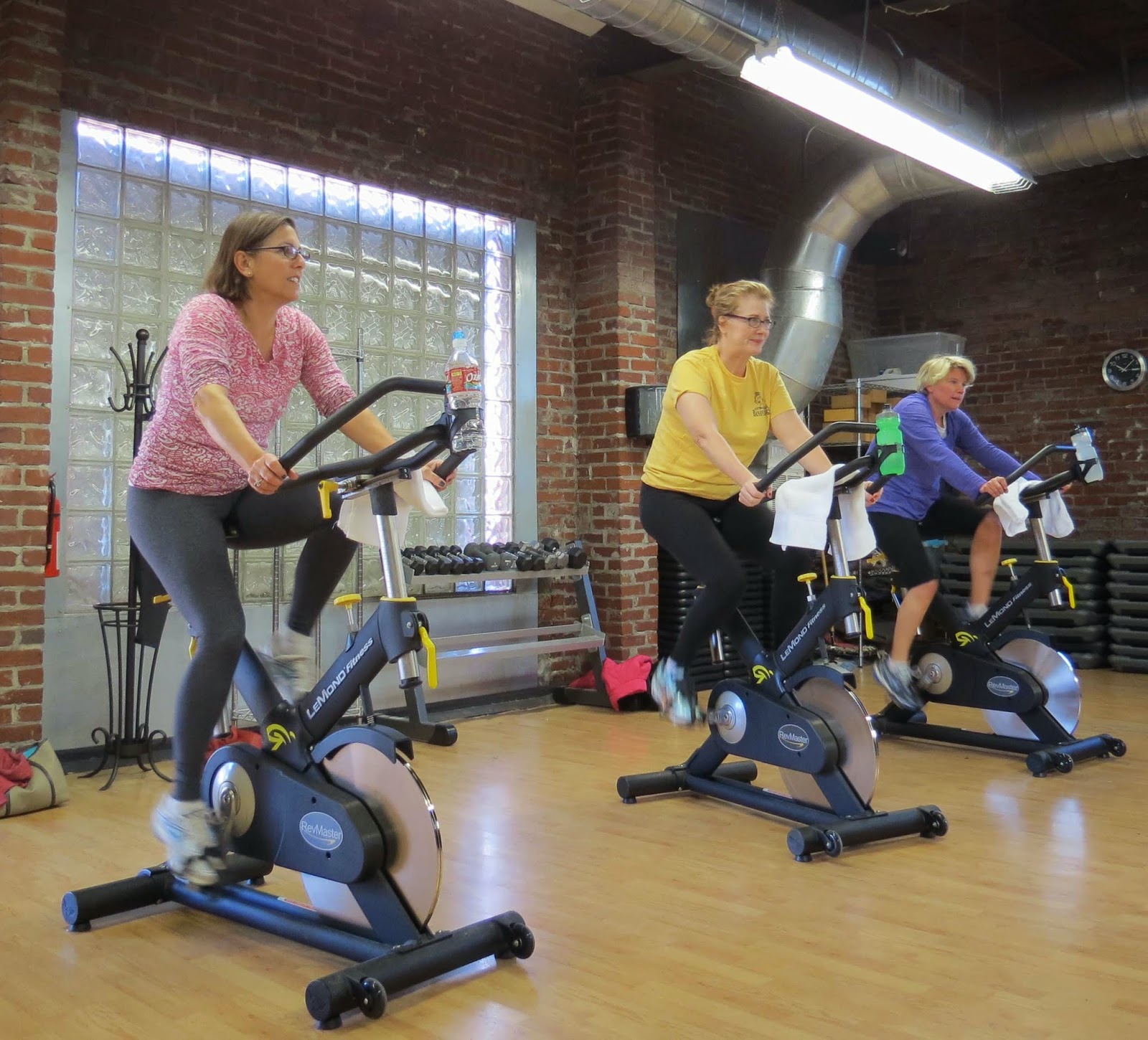
 Whether indoors or out, one of the best ways to improve abilities and
performance in cycling is to ride as often and with as much effort as you
can put into it.

If you are battling your weight, in Memphis, you are not alone.  Our city has one of the highest levels of obesity in the country and this was highlighted yet again in a recent article, dated April 17, 2014, in USA Today. 
To check your own body mass index (BMI), click on this link to the National Heart, Lung and Blood Institute website.

As necessary as it is to maintain, repair and to fine-tune your bike, it is also vitally important to do the same for your body.  Getting in shape means working out, which can be done at home, the gym, or in a health and fitness club.  Here is a link to the top 10 health or fitness clubs in the Memphis area.  There is also places like the Kroc Center where you can go to work out.

When doing this, your focus should be on strengthening your legs and core muscles, which are those that are located in your trunk and torso, (minus the arms and legs).  Some of the core muscles that you should work to develop include the abdominus (abs), obliques, lower back.  Below that, you should concentrate on firming up the gluteal muscles (glutes), the inner & outer thighs and calves. 

When exercising and strengthening these muscles, you should be doing more than just doing crunches and sit-ups, but should also include squats, lunges, push-ups, oblique twists & reaches,  plank & side plank exercises, one that is known as "the superman," and others.  The Mayo Clinic and About.com are two excellent websites that provide detailed step-by-step instructions on these exercises.  There are also a couple of great articles from bicycling.com entitled "Here's how to train the most important muscles for cycling" and "The best gym workout ever - Here's how to burn fat without being bored to tears."

In addition to these, you can incorporate weights and balancing balls into a workout regimen, but when it comes to weights, the idea is not to bulk up, but to firm up.  You may also want to consider Yoga & Pilate's since these can stretch and strengthen your muscles and can give you an alternative way to work out.

As with any work-out routines, it does not offer as much of a benefit to you if you do not do it with frequency or sufficient intensity.  It may seem cliché to some people, but there is a lot of truth in the phrase of "no pain, no gain" and you not expect to not hurt.  When you don't feel it, it is usually a sign that you are not working at it hard enough.


Time spent on a bike is one of the best ways to get better at cycling, but it
can be extremely beneficial to spend some time working out at the gym
with special emphasis on the core muscles and the legs.  When working with
weights, the idea should be to get firm instead of trying to bulk up.

Other than strength-building, it is equally important to improve your cardiovascular system either through aerobic (cardio) activities like running or workouts on gym equipment like a treadmill or elliptical machines.  More than just about anything else, though, running is probably one of the most helpful things that cyclists can do to improve their cycling.  It offers some cross-training benefits by not only strengthening muscles in the legs and lower torso, but it is also is one of the best aerobic workouts that you can do.

Besides time on the seat of a bike, cyclists can improve their performance with a combination of things that include time in the gym, or by doing aerobic activities other than cycling.  This, however, should not be a substitute to time spent on a bike.  The most progress, though, comes with cycling and especially when the riding is done as often and with as much intensity as you can put into it. 

Ultimately, there is no workout that is any better than that and nothing can compare to the overall healthy lifestyle that can come from doing what it takes to become a better cyclist.